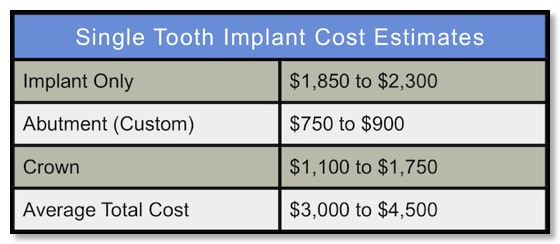
Above are some price ranges for dental implants. These prices do not include additional services such as sinus lifts, bone grafting, temporary stay-plates, etc. If you have questions about your specific costs, please call us. Though we try hard to standardize the pricing for patients, each case is unique.
Yes. The less complex a case is, the lower our cost. A typical dental implant, abutment, and crown package that patients pre-pay or take advantage of our cash bundle price is around $3,800+.
. The price may be more or less depending on the patient's insurance plans and the treatment they need.
We are amazed at how many people come to our office for Dr. Tsai to take a look, and we find their dentists haven’t discussed other options, possible complications, and other potential costs with them. So, we started offering a free of charge dental implant consultation1 to help patients figure out if implants are the best solution for them and, of course, if they are getting a fair price.

Why do we offer a no-charge second opinion on dental implants1? Getting a dental implant or implants is a major decision for patients. You should consider the clinical importance as well as the cost.
It is no secret, dental implants and crowns can add up on the cost. However, some offices charge much more than others for what appears to be, or what is essentially the same service.

Don’t get me wrong, there are places that offer very low cost dental implants, but I would be cautious of the quality of care you will receive. So, the questions you should ask when shopping around for low cost dental implants are:
» Does this price include the dental implant, bone graft (if you need it), abutment, and crown?
» Do you use real bone for my graft or do you use synthetic bone?
» Will the same doctor do my dental implant and the crown, or will I have to go to other doctors?
» If the dental implant fails, will I have to pay to have it repaired?
» What kind of dental implant do you use?

Failed root canals, loose and infected dental implants, crowns with cavities around the edge are all very common results from low-cost international dentistry. If you are determined to travel to Mexico, China, Thailand, or any other country that offers low-cost dentistry, here are a few rules to follow:
» Make sure you can communicate with the actual doctor who will do the procedures
» Understand all the risks with the treatment you will receive
» Have a plan in case something goes wrong with the dental implant, crown, etc.
» Talk to some patients who have had work done by that dentist - check his/her work
» Make sure you will be there long enough to complete the work
» Verify that they will use high-quality labs to do the work
» Factor in the price of your travel into the total cost of the dental work

Again, I would refrain from making a dental implant decision on price alone. While I understand that the cost of dental implants is a major part of your decision, I always recommend getting a second opinion and a second price for a few reasons. Most importantly, you get to meet another doctor or oral surgeon and see if he or she makes you feel more comfortable. You can also ask about their training, the type of implants they use and why, and, of course, if they can perform the implants all in the same office. Most of our patients like the fact that we do not refer patients out for implants. We do everything right here in our office.
About 90-95% of all dental implants are successful. That may seem like a low number to some people, but keep in mind that there are many factors that can cause a dental implant to fail. You have control over most of them. The number one reason a dental implant may fail is smoking. Sorry smokers, but dental implants and the bone that supports them do not like smoke. The second common reason that dental implants may fail is periodontal disease of the patient's gums. When left untreated, their gums can recede and expose the implant. So, if we stop the smoking and take care of our gums, the success rate of dental implants is up near 98%. If you have any concerns about these issues, please let us know. We’ll do everything we can to help you better understand them for your situation.
Very. Dental implants are as strong as the bone they attach to. Below I have a video that shows the implant process, and how your implant will integrate with your jaw bone. Once this is bone integration is complete, we attach an abutment and your final implant crown. With proper care (cleaning your teeth, keeping your gums healthy, and no smoking), your dental implant will last a lifetime.
Many patients are concerned about the process or procedure of placing a dental implant. Once they find out how common and well-understood the treatment is, they are able to relax. Most dental implants can be placed in an hour or so. After the implant is placed, you will return to our office for a follow-up visit to make sure everything is healing properly. Then, about four to six months later, we will place the final crown and abutment. Below, I have posted a video from YouTube that illustrates the implant process.

In recent years, it has become very common to use mini dental implants or full dental implants to solve this problem. The results are amazing. Imagine having your denture or partial locked into place during the day, and then be able to remove it while sleeping and for cleaning. Dental implants can make this possible.
Though every implant case is unique, we allow four to six months of healing time after the implant is placed. During this time, your natural bone is growing up to, and integrating with, your newly placed dental implant. Implants are made of titanium which is safe, strong and light. Once the bone has healed around your implant, we place the abutment and the crown. This is the last step. The implant process, from start to finish, usually takes four to six months.
Absolutely. Dental insurance usually covers as much as 50% of the total cost of your dental implant. However, every dental insurance plan is different, so we would need to check with yours. Sadly, some employers exclude dental implant cover from employee dental plans. Just call or email our office to set up a free dental implant consultation appointment. We will give you an insurance estimate of your copay after we make sure you’re a suitable candidate for dental implants.
» Oral Surgeons and Dental Implants
» All Ceramic Dental Implants
» Dental Implants, Bridges, Crowns, & Partial Dentures
» Bone Grafting & Sinus Lifts
» Second Opinions for Dental Implants
» Cracked Tooth Syndrome
» Frequently Asked Questions about Dental Implants
» How to calculate your dental insurance copays?
» Before and After photos of our patients
» Z-SYSTEMS® All Ceramic Dental Implants
Have questions about dental implants or mini dental implants?
email or call us: (650)-583-5880
We'd love to hear from you.
📩
Send us Email
📅
Request Appointment
1Consultation is for new placement dental implant related treatment only.